Download statistics and more than 1.5 years of continuous measurement data show that an increasing number of users are downloading more and more data from the ARP Data Repository - it is therefore clear that the ARP is not merely an archiving service or a passive data repository, but functions as an active, live data source and a dissemination platform.
The ARP Data Repository has been publicly accessible since November 2024, and since then, a steady, significant upward trend has been observed in both data uploads and downloads. Furthermore, the repository has not experienced a single “downtime” period; in other words, the system has been continuously active.
By December 2025, users had initiated more than 233,000 downloads from the ARP Data Repository. Nearly two-thirds of these, ~140,000 downloads, occurred in the past 6 months, which clearly reflects that ARP’s knowledge dissemination efforts, the energy invested in fostering a culture of open science in Hungary, and the specific activities related to these missions - such as the HUN-REN Data Scientist Network, the ARP Ambassador Program, the “Kincs, ami van” (Find a Treasure) roundtable discussion series, and the ARP Roadshow - are gradually making an impact on the activities of individual institutions and researchers. The figures show that over the past 6 months, the daily average number of downloads exceeded 760.
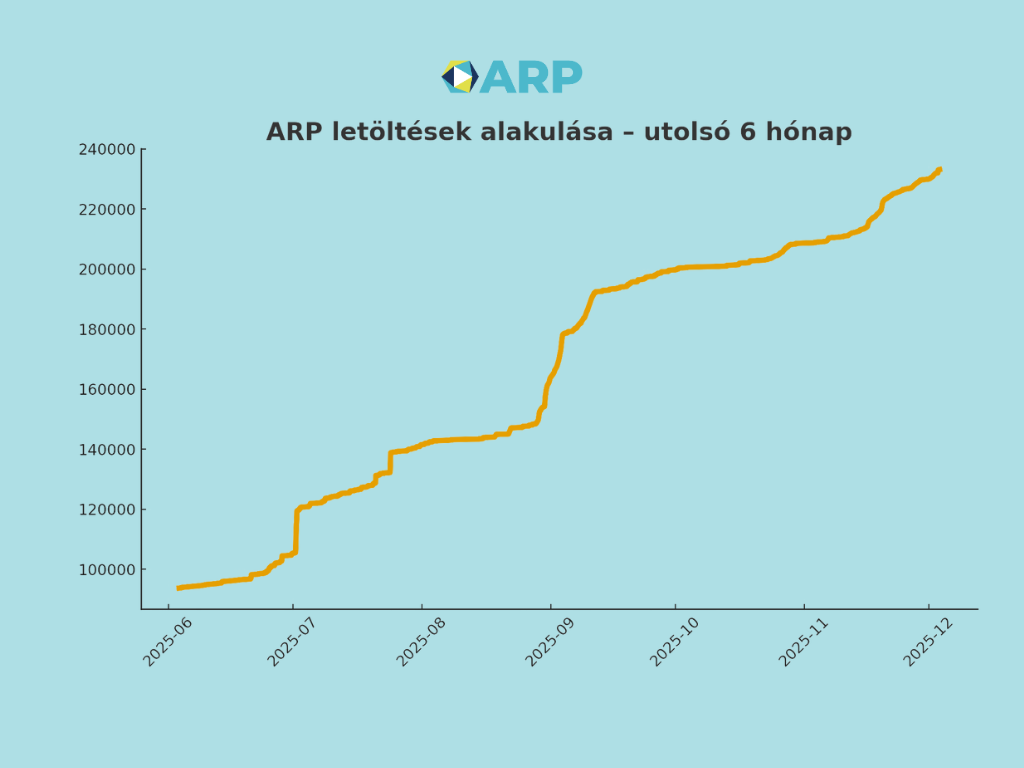
The ARP system currently contains thousands of metadata entities, files, and large-scale research datasets: 211 published dataverses, 137 complex datasets, and more than 34,000 files.
The popularity of ARP stems, on the one hand, from the fact that it operates within a federated structure that includes the entire HUN-REN research network and is open to Hungarian higher education institutions, making it inherently interdisciplinary. On the other hand, it features a metadata - and file- level descriptive system, which ensures that the data is easily discoverable and interpretable. Despite the relative “youth” of the ARP infrastructure, it has very quickly become an active community data resource, which further confirms that there is a domestic need for such a platform.