A major milestone in ARP’s international dissemination was the 2025 Dataverse Community Meeting organized by Harvard, held in Chapel Hill, North Carolina.
This invitation was preceded by a presentation during the January Dataverse Community Call, where a CoS (Center for Open Science) staff member demonstrated how CEDAR schema templates are used in OSF (Open Science Framework). At this meeting, Balázs Pataki, developer from SZTAKI DSD, gave an ad hoc demonstration of the deep integration between ARP and CEDAR.
The presentation received unexpectedly enthusiastic feedback, and the Harvard Dataverse developers considered it important enough to invite us to present these developments at the upcoming Dataverse Community Meeting in Chapel Hill. There, László Kovács, head of SZTAKI DSD and Balázs Pataki, lead developer from SZTAKI DSD, demonstrated how the integration of the CEDAR schema registry, combined with RO-Crate–based export, import and editing capabilities introduced into Dataverse - with our AROMA RO-Crate editor - enables significantly more detailed and efficient metadata annotation, making the creation of FAIR data packages significantly easier.
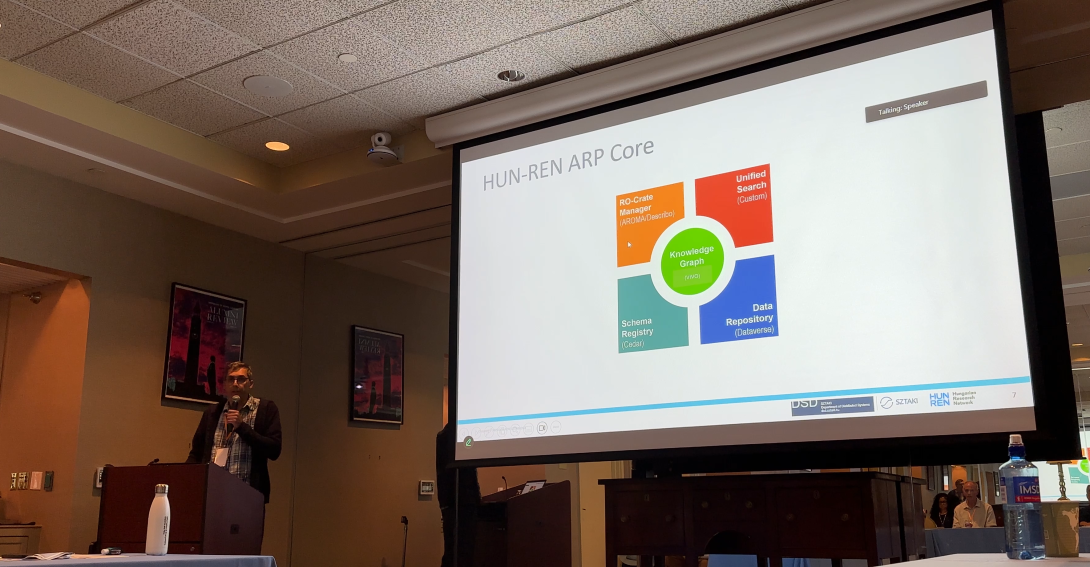
During our visit to the United States, the CEDAR development team at Stanford also invited Balázs Pataki, the lead of the Dataverse–CEDAR integration project, to give a presentation on how this integration was implemented within Dataverse, and what additional enhancements we introduced in CEDAR to support more efficient metadata schema creation and sharing, especially focusing on schema versioning.
These innovations are currently available only in ARP’s own Dataverse and CEDAR versions. Following the presentations and discussions, the Harvard Dataverse developers asked us to contribute these CEDAR and RO-Crate integration features to the core Dataverse codebase so that they can be included in a future official release. This will make our developments directly available to all Dataverse installations and users worldwide.